
Can Standard Rockwell Hardness Testers Improve Reliability of Laboratory Material Performance Testing
Read:22
Many laboratory material performance tests cannot be accurately evaluated by appearance or metallographic structure alone. Although a sample may look uniform and qualified on the surface, it may contain hidden defects such as unstable hardness, uneven heat treatment, material composition deviation, and unqualified mechanical properties. When developing metal materials, heat-treated parts, mold steels, alloy products, and precision components, small hardness errors in laboratory samples can lead to serious problems in pilot production and mass production, such as insufficient wear resistance, easy fracture, and unqualified batch quality.
Foosean specializes in the R&D, manufacturing and sales of precision hardness testing equipment, providing reliable Rockwell hardness testing solutions for laboratories and industrial fields. The company's products are widely used in scientific research institutions, metal processing, machinery manufacturing, aerospace, auto parts, hardware tools and other industries, and provide customized testing equipment and technical support for global customers.
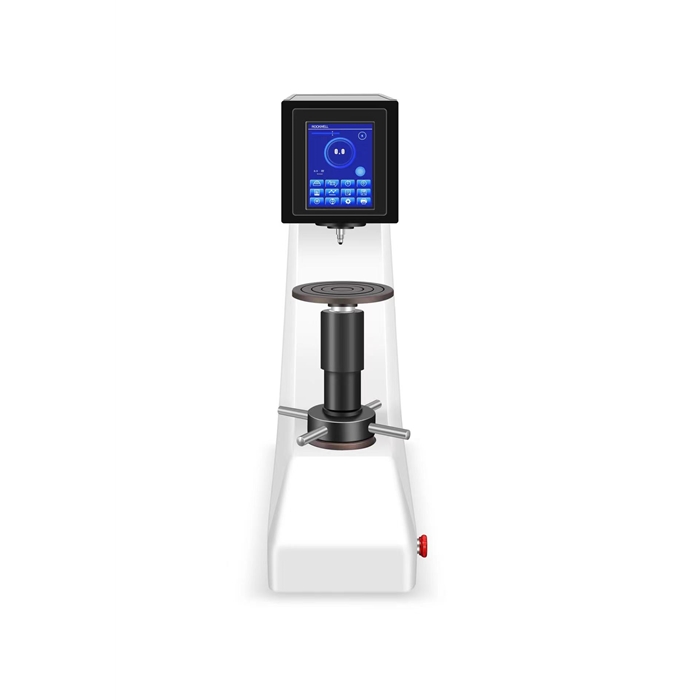
Why Does Standard Rockwell Hardness Testing Matter in Lab Research?
Rockwell hardness testing is not only about obtaining a hardness value. In material laboratory research, it also helps verify whether materials can maintain stable mechanical properties under different processes, heat treatments, and processing conditions, and whether the performance meets the design requirements. This is crucial because laboratory test data directly guides the formulation of production processes and quality standards, not just for simple sample testing.
Eliminate Hidden Defects and Ensure Test Accuracy
Foosean Rockwell hardness testers adopt the principle of preload + main test force, measuring the residual depth of indentation to convert hardness values. For metal materials, surface roughness, uneven stress, and improper operation will cause test errors. Foosean standard Rockwell testers with precise loading systems can avoid these interference factors, truly reflect the material's hardness, and provide a reliable basis for material screening and process optimization.Common applicable materials include carbon steel, stainless steel, aluminum alloy, copper alloy, cemented carbide, annealed steel, and surface-hardened parts, covering most metal laboratory test scenarios.
Reduce Oxidation, Deformation and Test Interference
Laboratory materials are easily affected by the external environment during testing. Some materials will oxidize, deform or change performance after long-term exposure to air, resulting in inaccurate test results. Rockwell hardness testing has small indentation, fast testing speed, and minimal damage to samples, which can reduce material performance changes caused by long-term testing. At the same time, Foosean's closed-loop force control systems avoid excessive pressure damage to materials, providing a pure and stable test environment for laboratory samples.
How Does Standard Rockwell Testing Change Material Performance Evaluation?
Standard Rockwell hardness testing improves the accuracy and repeatability of test data, making material performance evaluation more scientific and credible. It unifies test standards, eliminates human errors, and allows different batches and different laboratories to obtain comparable data.
More Stable Test Process
High-precision Foosean Rockwell hardness testers realize automatic loading, automatic dwell time, and automatic unloading, avoiding data errors caused by manual operation differences. The rigid body structure reduces the impact of environmental vibration, ensuring that the test force is accurately applied. Even for small and precise laboratory samples, stable and consistent test results can be obtained.
Complete Standard Compliance and Traceable Data
Laboratory test data needs to be repeatable and traceable. Foosean standard Rockwell hardness testers comply with GB/T 230.1, ISO 6508, ASTM E18 and other international standards, with test force error controlled within the standard range. Equipped with standard hardness blocks, regular calibration can be carried out to ensure that the set value, displayed value and actual test value are consistent.The digital display model can store data, export reports, and facilitate laboratory data management.
When Is a Foosean Laboratory Rockwell Hardness Tester the Better Choice?
Laboratory Rockwell hardness testers are not just simple testing tools. They must have high precision, easy operation, strong adaptability to samples, and can provide repeatable data for material research. Users most concerned about: whether the laboratory test data can truly reflect material performance and guide production.
High Precision and Strong Versatility
Foosean laboratory Rockwell hardness testers support multiple scales such as HRC, HRB, HRA, covering soft materials like aluminum and copper to hard materials like quenched steel and cemented carbide. The contact parts are made of high-hardness and wear-resistant materials, with long service life, suitable for long-term high-frequency testing in laboratories.
For materials with high hygiene and precision requirements, the equipment has a simple structure, easy cleaning, no pollution to samples, and meets the testing needs of precision parts and high-purity metal materials.
Small Sample Adaptation and Low Material Loss
Laboratory samples are mostly small in size and high in cost. Rockwell hardness testing has small indentation and little damage to samples, and the tested samples can be used for other performance tests, reducing the waste of expensive materials. Foosean instruments are ideal for small-batch sample testing in material research, new product development and process optimization.
What Test Problems Can Standard Foosean Rockwell Testers Solve?
Rockwell hardness testers can solve many problems that ordinary testing methods cannot. Simple manual testing or improper equipment will lead to distorted data, while standard Foosean testers optimize the test process from the root.
Unstable Data and Poor Repeatability
Unstable test data is a common problem in laboratories, which is related to uneven loading, improper sample preparation, and equipment accuracy. Foosean standard Rockwell hardness testers eliminate the interference of human factors and environmental factors, with high test repeatability, ensuring the stability and reliability of each test result.
Difficult Testing of Special Samples
Small-sized, thin-plate, and special-shaped samples are difficult to test with conventional methods. Foosean Rockwell hardness testers are equipped with multiple anvils, suitable for flat, cylindrical, and thin samples, solving the testing difficulties of various special laboratory samples.
How Should Safety and After-Sales Support Be Checked?
Although the Rockwell hardness tester is small in size, its safety and stability cannot be ignored. It involves precision machinery , requiring safe operation and professional maintenance.
Safety and Compliance
Foosean equipment has a stable structure, no exposed moving parts, and safe operation. It complies with international safety standards, and the digital model has an automatic stop function to avoid misoperation. For laboratories with special requirements, it can meet relevant certification and use standards.
After-sales Service
Foosean provides one-year warranty, lifelong technical consultation, remote guidance, operation training and maintenance support. Equipped with English manuals, standard hardness blocks and spare indenters, facilitating users' daily use and calibration.
How Should You Decide if a Standard Rockwell Hardness Tester Is Worth It?
It is worth choosing a standard Rockwell hardness tester when you need to test material hardness accurately, study material properties, optimize processes, and require repeatable and traceable test data. Ordinary rough testing is cheap, but wrong data will lead to wrong process decisions and greater losses.The selection checklist includes: material type, hardness range, sample size, test standard requirements, data export needs, and future application expansion.
FAQ
Q1: Can standard Rockwell hardness testers improve laboratory material test reliability?
A: Yes. It can reduce test errors, improve data repeatability, accurately reflect material hardness, and provide reliable support for material research and quality control.
Q2: What is the main advantage of a Foosean laboratory Rockwell hardness tester?
A: High precision, small indentation, less sample damage, multiple scales, wide application range, and can provide standardized and repeatable test data.
Q3: Why is standard configuration important for Rockwell hardness testers?
A: Standard configuration ensures compliance with international test standards, stable performance, accurate data, and traceable test results.
Q4: When should you choose a digital Foosean Rockwell hardness tester?
A: Choose a digital model when you need automatic data storage, report export, automatic loading and unloading, and higher test efficiency and accuracy.
Q5: What information should be provided before asking Foosean for a quotation?
A: Provide material type, expected hardness range, sample size, test standard requirements, functional needs (digital/dial), and supporting accessories requirements.